Farmland and Agricultural Property in Dahlonega: A Buyer's Guide
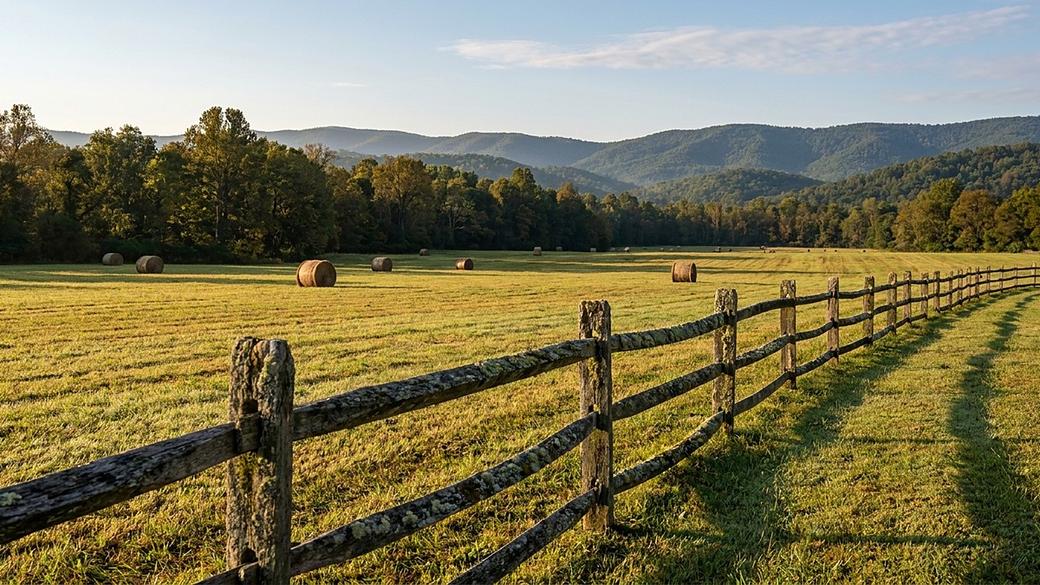
Dahlonega Land and Acreage
Farmland and Agricultural Property in Dahlonega: A Buyer's Guide
By Gold Peach Realty
TL;DR quick answer
Most farm land around Dahlonega sells with a tax covenant already attached to it. Georgia's conservation use program can cut the taxable assessment sharply, but it binds the land for 10 years, and breaking it costs twice the tax saved on the entire tract. Read the covenant before you write an offer.
On this page
What counts as farmland in Georgia?
In North Georgia the honest answer is that farmland is a tax classification before it is a landscape. A pasture with two horses on it and a hayfield of the same size can carry very different tax bills, and the difference is which state program the owner enrolled in. Georgia runs three of them, and they are not interchangeable. If you are still deciding between acreage and an established property, start with the current inventory of Dahlonega homes for sale at Gold Peach Realty and work outward from there.
The baseline first. Georgia property is assessed at 40 percent of fair market value unless some other law says otherwise, under O.C.G.A. 48-5-7. Each agricultural program changes that baseline in a different way.
40%
of fair market value: the standard Georgia assessment ratio
30%
under preferential agricultural assessment, which is 75 percent of the assessment of other property
Use
conservation use is assessed on current use value instead of fair market value
Ratios and the conservation use basis as published by the Georgia Department of Revenue, Property Tax Valuation, citing O.C.G.A. 48-5-7 and 48-5-7.1.
Those three columns are the whole decision. Conservation use is the one most Lumpkin County sellers are enrolled in, because on land that would otherwise be appraised for its development potential, valuing it on what it currently produces is worth far more than a ratio cut.
| Program | Acreage limit | Covenant | Authority |
|---|---|---|---|
| Conservation use (CUVA) assessed on current use value |
Not more than 2,000 acres of a single person | 10 years, renewable in the 9th year without a lapse | O.C.G.A. 48-5-7.4 |
| Preferential agricultural assessed at 30 percent of fair market value |
2,000 acres per beneficial interest | 10 years, renewable | O.C.G.A. 48-5-7.1 |
| Forest Land Protection Act for working timber tracts |
At least 200 acres in aggregate, in parcels of at least 100 acres within any given county | 10 years | O.C.G.A. 48-5-7.7 |
Each row is drawn from the statute text reproduced in the Georgia Department of Revenue's rural land appraisal course. Note the Forest Land Protection Act covenant term: the statute says 10 years, although secondary summaries of that program frequently describe it as a 15-year commitment. Confirm the term on the recorded covenant itself, not on a summary.
Qualifying uses under conservation use are broader than most buyers expect. Raising or storing crops, managing livestock or poultry, producing timber, aquaculture, horticulture, dairy and apiarian products all count, and so does wildlife habitat of not less than 10 acres, either in its natural state or under management. A tract that looks like woods to a buyer can be enrolled and productive in the eyes of the tax code.
Ownership is narrower. Conservation use property must be owned by natural or naturalized citizens, an estate or trust whose beneficiaries are such citizens, a qualifying family owned farm entity, a 501(c)(3) nonprofit conservation organization, or a bona fide club organized for pleasure and recreation. A family owned farm entity has to have derived 80 percent or more of its gross income from bona fide conservation uses in the year before eligibility is sought, and its owners must be related within the fourth degree of civil reckoning. If you are buying through an LLC formed last month, check this before you rely on the covenant continuing.
The house is not in the covenant. Conservation use excludes the entire value of any residence and its underlying property, and the statute defines underlying property as the minimum lot size required for residential construction by local zoning ordinances or 2 acres, whichever is less. That exclusion applies to property first placed under covenant, or renewed, on or after May 1, 2012. So a farm with a house on it is really two tax objects, and only one of them is getting the break.
The covenant is the real transaction
Buyers tend to treat the tax break as a feature of the property, like a barn. It is not. It is a contract with the county that runs with the land for 10 years, and the penalty for breaking it is deliberately severe.
What a breach costs
O.C.G.A. 48-5-7.4(l) states that the penalty "shall be applicable to the entire tract which is the subject of the covenant and shall be twice the difference between the total amount of tax paid pursuant to current use assessment under this Code section and the total amount of taxes which would otherwise have been due under this chapter for each completed or partially completed year of the covenant period."
Read that twice. The penalty is not limited to the acre you disturbed. It reaches the entire tract, it is doubled, and it reaches back across every year of the covenant, including a partially completed one.
There is a real protection built in alongside it, and it is the part secondary summaries usually drop. Under O.C.G.A. 48-5-7.4(k.1), the board of tax assessors must notify the owner in writing of an alleged breach, and the owner then has 30 days to cease the activity or to remediate the condition. No penalty may be imposed until any appeal of the assessors' determination is concluded, and after a final determination the taxpayer has 60 days from the issuance of the bill to pay in full. An accidental breach discovered early is often curable. An unread notice is not.
What to verify before you sign
- Pull the recorded covenant from the Superior Court clerk's real property records, not the listing sheet. You want the approved application as filed and indexed.
- Find the start year. The term runs from January 1 of the year the property first qualified. A covenant in year 8 is a very different proposition from one in year 2.
- Confirm which program it is. Conservation use, preferential agricultural, and forest land conservation use have different rules and different paperwork.
- Check that your ownership structure qualifies under the statute's ownership list before you assume you can continue the covenant.
- Ask the county what it considers the qualifying use on this specific tract, and what would end it. Then price the risk into your offer.
Start with the local inventory
Acreage moves differently than houses here, and covenant status is rarely on the listing sheet. Search all Dahlonega homes for sale at Gold Peach Realty to see what is active, then call us before you tour a working tract.
Gold Peach Realty · (770) 283-1223
Buying land that is already under covenant
This is the question that decides most farm land deals in Lumpkin County, and there is a specific sentence in the statute that answers it.
When a conservation use application is approved, the board of tax assessors files a copy with the clerk of Superior Court, who indexes it in the real property records. O.C.G.A. 48-5-7.4 then says plainly that "if the application is not so recorded in the real property records, a transferee of the property affected shall not be bound by the covenant or subject to any penalty for its breach."
Recording is what makes a covenant follow the land to you. That single fact cuts both ways, and both directions matter at the closing table. If the covenant was properly recorded, you inherit the remaining term and the penalty exposure that comes with it. If it was not recorded, you are not bound, but you should also not assume the tax treatment simply continues. Either way, this is a title question, and it belongs in the title search rather than in a conversation with the seller.
A change of ownership does not automatically end the benefit. The statute contemplates a new application after a transfer, filed on or before the last date for filing tax returns in the year following the year the change in ownership occurred. Missing that window is one of the more common and more expensive unforced errors in an acreage purchase, so put the date in your closing file.
Two further provisions are worth knowing because they come up constantly on family land. First, the penalty in subsection (l) does not apply where the covenant is breached solely because of acquisition under the power of eminent domain, a sale to an entity that could have exercised that power, or the death of an owner who was a party to the covenant. Second, under subsection (o), transferring part of the tract to a relative within the fourth degree of civil reckoning for single-family residential use is not a breach, provided the use starts within a year, the residence is occupied within 24 months, and the total transferred to that relative during the covenant period does not exceed 5 acres. The carved-out piece leaves the conservation use covenant, and the remainder continues under it.
If you are weighing raw acreage against something already improved, our Dahlonega acreage and land buying guide walks the due-diligence sequence in more detail, and you can browse current Dahlonega land for sale alongside it.
What Lumpkin County actually regulates
Here is where buyers coming from metro Atlanta get surprised, and where a lot of published advice about North Georgia land is simply wrong.
Lumpkin County does not run a conventional district-based zoning map with an A-1 agricultural district and a table of minimum lot sizes. The county's own published answer to the question is direct: "Lumpkin County currently has a performance-based zoning referred to as the Lumpkin County Land Use Code, which is a non traditional type of zoning that regulates uses through setbacks and buffers."
That distinction changes your entire diligence approach. You are not looking up a district letter and reading its permitted-use list. You are asking what the Land Use Code requires by way of setbacks and buffers for the specific thing you intend to do on the specific tract you are buying. Two adjacent parcels can support very different operations depending on what surrounds them.
Because that structure is performance based, this article does not publish setback or buffer figures. Those numbers belong to the current Land Use Code text, and the right move is to take your intended use to the Lumpkin County planning office before you go under contract rather than to rely on any article, including this one. Ask them specifically about the use you want, not about the parcel in general.
Water, septic, and access on a working tract
Tax treatment gets the attention. Infrastructure decides whether the land does what you bought it for.
- Water. Most agricultural tracts here run on a private well. Yield varies considerably across this terrain, so a well test belongs in your due-diligence period. Withdrawing surface water for irrigation at scale is separately regulated by the state, which is a permitting question rather than a real estate one.
- Septic. A septic system needs a suitable absorption field, not just a tank location, and on sloped or narrow ground the drainfield is usually the binding constraint. Soil suitability is determined by the county environmental health office.
- Access. Confirm legal access, not merely a driveway you can drive on. Deeded easements, shared drives, and unrecorded farm roads are common on land that has stayed in one family for decades.
- Boundaries. Older agricultural deeds around Lumpkin County can rely on descriptions that predate modern survey practice. A current survey is worth its cost on acreage.
If part of the appeal is a residence on the land rather than a bare tract, it is worth comparing what is available among Dahlonega cabins for sale and Dahlonega luxury homes, since a house already served by a working well and septic system removes a large share of this list.
Georgia's right-to-farm protection
If you intend to actually farm, this is the statute that protects you from your future neighbors, and it is short enough to read yourself.
O.C.G.A. 41-1-7(c) provides that no agricultural facility or operation "shall be or shall become a nuisance, either public or private, as a result of changed conditions in or around the locality of such facility or operation if the facility or operation has been in operation for one year or more." The protection is aimed squarely at the pattern where houses arrive next to an established farm and the new arrivals then object to the farm.
It has a real limit. The same subsection says the protection "shall not apply when a nuisance results from the negligent, improper, or illegal operation of any such facility or operation." Right to farm shields ordinary agriculture from changed surroundings. It does not shield a badly run operation.
The mirror image matters if you are buying a rural homesite rather than a farm. If there is an established agricultural operation next door, this statute is the reason you should assume its ordinary noise, dust, and odor are permanent features of the property you are considering.
GATE, the producer sales-tax exemption
Separate from property tax, Georgia runs a sales and use tax exemption for qualified agriculture producers under O.C.G.A. 48-8-3.3, administered by the Georgia Department of Agriculture as the Georgia Agricultural Tax Exemption, or GATE.
Per the Department's published program materials, individuals or businesses that have earned or expect to earn at least $5,000 on an annual basis from qualified agricultural activities are eligible, and qualified activities can be aggregated across multiple crops. Applicants must have prior tax forms on file demonstrating that income, or provide the Agriculture Commissioner with enough documentation for a discretionary approval. As of the 2019 production year, cards are issued for a 3 year term, and a three-year exemption costs $150. Applications are processed and paid for electronically.
Treat GATE as a working-farm decision rather than a closing-table one. It follows the operator, not the parcel, and it does not affect the conservation use covenant in either direction. Verify current eligibility rules and pricing with the Department of Agriculture before you budget around it.
Putting it together
Farm land around Dahlonega rewards patience and punishes assumptions. The tract is usually worth what its current use and its covenant say it is worth, not what a comparable subdivision lot suggests. The three things that most often change a buyer's number are the covenant term remaining, whether the recorded documents actually bind a transferee, and what the Lumpkin County Land Use Code will let the buyer do with the ground.
None of that shows up in a listing photograph. It shows up in the clerk's records, in the assessors' file, and in a conversation with the planning office, which is exactly the work worth doing before you fall in love with a view. For a broader read on where local values are heading, our Dahlonega market report tracks the wider picture, and the guide to buying a cabin in Dahlonega covers the improved-property side of the same market.
Frequently asked questions
Is there farm land for sale in Dahlonega right now?
Yes, though agricultural tracts trade less frequently than houses and often sell before they are widely marketed. Active inventory changes daily, so rather than quote a count that would be wrong by the time you read it, we point buyers at the live listings. Browse Dahlonega homes for sale with Gold Peach Realty or call (770) 283-1223 to be told about acreage before it hits the market.
Does a conservation use covenant transfer to me when I buy the land?
It binds you only if the approved application was recorded in the real property records. O.C.G.A. 48-5-7.4 states that if the application is not so recorded, a transferee is not bound by the covenant or subject to any penalty for its breach. Make it a title question rather than a seller question.
How long does the covenant last?
Conservation use runs 10 years from January 1 of the year the property first qualified. The owner may renew in the 9th year so the contract continues without a lapse for another 10 years. Preferential agricultural and forest land conservation use covenants also run 10 years under their own statutes.
What happens if I break the covenant?
Under O.C.G.A. 48-5-7.4(l) the penalty applies to the entire tract and is twice the difference between the tax paid under current use assessment and the tax that would otherwise have been due, for each completed or partially completed year of the covenant period. You are notified first and have 30 days to cease or remediate, and no penalty is imposed until any appeal is concluded.
Are there exceptions to the breach penalty?
Yes. The penalty does not apply where the covenant is breached solely because of acquisition under the power of eminent domain, a sale to an entity that would have had that power, or the death of an owner who was a party to the covenant.
Can I build a house for a family member on covenanted land?
The statute allows it in a narrow lane. Transferring part of the tract to a relative within the fourth degree of civil reckoning for single-family residential use is not a breach if the use starts within a year, the residence is occupied within 24 months, and the total transferred to that relative during the covenant period does not exceed 5 acres.
How many acres can be enrolled in conservation use?
Not more than 2,000 acres of a single person, under O.C.G.A. 48-5-7.4(a)(1). Preferential agricultural assessment carries the same 2,000 acre ceiling per beneficial interest. Special allocation rules apply to family owned farm entities.
Does the house on the farm get the tax break too?
No. Conservation use excludes the entire value of any residence and its underlying property, defined as the minimum lot size required for residential construction by local zoning ordinances or 2 acres, whichever is less, for covenants first entered or renewed on or after May 1, 2012.
Does woodland qualify, or does it have to be a working farm?
Timber production qualifies, and so does wildlife habitat of not less than 10 acres, either in its natural state or under management. A tract does not have to look like a farm to be enrolled.
What zoning district is agricultural land in Lumpkin County?
Lumpkin County does not use that structure. The county describes its system as performance-based zoning under the Lumpkin County Land Use Code, a non traditional type of zoning that regulates uses through setbacks and buffers. Take your specific intended use to the county planning office rather than looking for a district letter.
Will Georgia's right-to-farm law protect my operation?
O.C.G.A. 41-1-7(c) provides that an agricultural facility or operation does not become a nuisance as a result of changed conditions around it once it has been in operation for one year or more. That protection does not apply where the nuisance results from negligent, improper, or illegal operation.
What does a GATE certificate cost?
The Georgia Department of Agriculture publishes a $150 cost for a three-year exemption, with cards issued for a 3 year term as of the 2019 production year, for producers earning or expecting at least $5,000 annually from qualified agricultural activities. Confirm current terms with the Department before relying on them.
About the figures in this article
Every statutory figure above is quoted from the Georgia statutes as reproduced in the Georgia Department of Revenue's rural land appraisal course, from Department of Revenue Form PT-283A, from the Department of Revenue's Property Tax Valuation page, from the Georgia Department of Agriculture's published GATE program materials, or from the text of O.C.G.A. 41-1-7. Statutes and program terms change, and the agency copy of O.C.G.A. 48-8-3.3 consulted for the GATE section states that it is current only through the 2022 Regular Session. Verify anything you intend to rely on against the current code and with the county before you act on it.
Some figures are deliberately absent. This article publishes no price per acre and no active listing count for Dahlonega farm land, because the available figures either change daily or trace back to estimates and brokerage sources rather than to a verified market record, and a circular citation is worse than a gap. It publishes no setback or buffer measurements from the Lumpkin County Land Use Code: the county states the structure of its system, which is reported here, but the ordinance text itself could not be read from the county's code host at the time of writing, so no numbers from it are quoted. It publishes no per-acre conservation use value, since those are set by soil productivity class and county. And it asserts no general minimum tract size for conservation use, because the statute text consulted sets a 2,000 acre ceiling and a 10 acre floor for the wildlife-habitat use specifically, not a general minimum. Nothing has been estimated to fill any of these gaps.
This article is general information about Georgia law and Lumpkin County practice. It is not legal, tax, or engineering advice. Consult a Georgia attorney, a tax professional, and the county offices for guidance on a specific parcel.
Work with a local North Georgia REALTOR
Covenant status, access, and water are the three things that most often change what a tract is worth. We read those before you make an offer. Get in touch with Gold Peach Realty, or if you are on the other side of the transaction, find out what your North Georgia land is worth.
Call (770) 283-1223 or email [email protected]
Looking for homes in North Georgia? Visit Gold Peach Realty at goldpeachrealty.com, your local experts in Dahlonega, Gainesville, and the surrounding mountain communities. Call (770) 283-1223.
Gold Peach Realty, Georgia real estate brokerage license 381292. Equal Housing Opportunity. All information deemed reliable but not guaranteed.
Categories
- All Blogs (664)
- Achasta Golf Community (78)
- Cleveland, GA (47)
- Dacula, GA (43)
- Dahlonega GA (166)
- Dawsonville, GA (46)
- Forsyth County, GA (2)
- Gainesville, GA (47)
- Gold Peach Realty (36)
- Helen, GA (44)
- Home Buying Tips (42)
- Home Décor And Interior Design (7)
- Home Improvement Tips (15)
- Home Selling Tips (29)
- Homes For Sale (56)
- Lake Lanier, GA (72)
- Land & Acreage (2)
- Local Events (13)
- Local Guides (27)
- Luxury Real Estate (3)
- Market Reports (17)
- Mortgage And Finance Tips (27)
- New Construction (2)
- North Georgia (47)
- Relocating To North Georgia (19)
Recent Posts


GET MORE INFORMATION