Fixer-Upper Homes in Dahlonega, GA: What to Know Before You Buy One
Dahlonega and Lumpkin County
Fixer-Upper Homes in Dahlonega, GA: What to Know Before You Buy One
By Gold Peach Realty
TL;DR quick answer
A fixer-upper in Dahlonega is a financing question and a permission question at the same time. Renovation mortgages let you fund the purchase and the repairs in one loan. Georgia law decides who may do the work, the city or the county decides what needs approval, and federal lead rules decide how a pre-1978 house may be worked on at all.
About the figures in this article
Every number below comes from a named public source read live on August 8, 2026 and is labeled with what it measures. Loan program limits, local fees, meeting calendars and statutory provisions change. Confirm anything you intend to rely on with your lender, the City of Dahlonega, Lumpkin County or your own attorney before you act on it.
See what is actually for sale in Dahlonega
Renovation candidates do not sit in a separate category on the MLS. The fastest way to find them is to look at the whole market with someone who knows which listings are worth walking.
Browse Dahlonega homes for sale
Or call Gold Peach Realty at (770) 283-1223.
On this page
- How you actually pay for the work
- City of Dahlonega or unincorporated Lumpkin County
- The historic district question, answered properly
- Pre-1978 paint, and the two rules people confuse
- Who is legally allowed to do the work
- What to settle before you write the offer
- Frequently asked questions
- About the figures and what we withheld
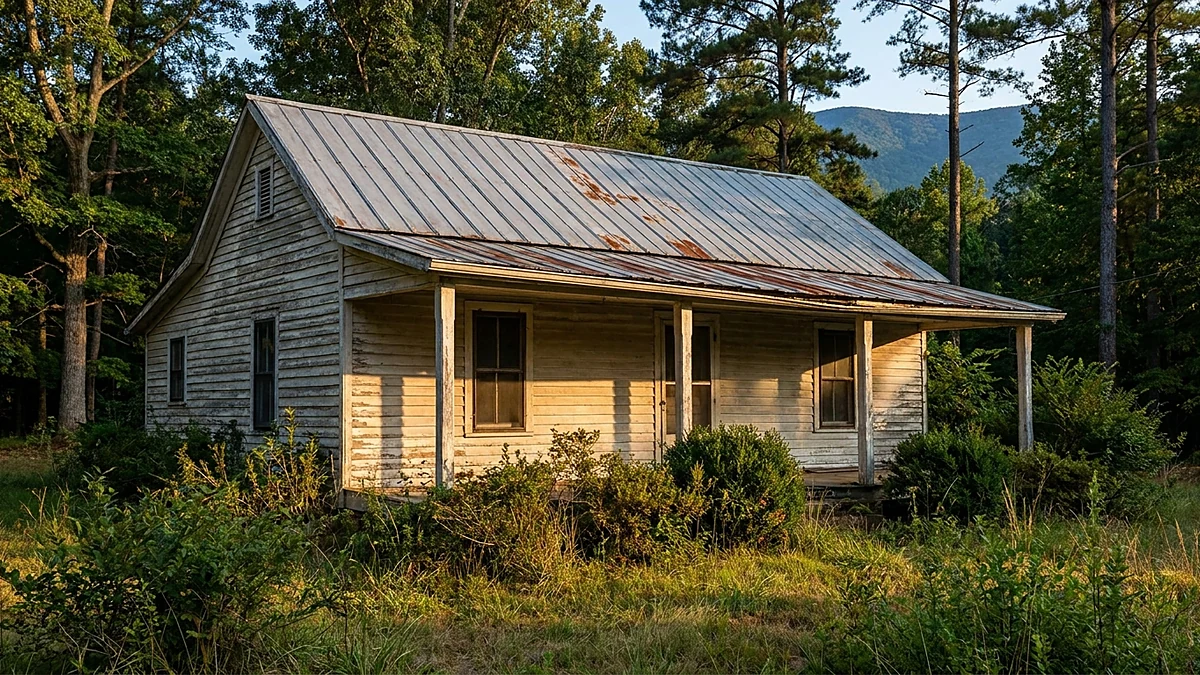
Dahlonega has the housing stock that makes a fixer-upper worth considering. There are cottages within walking distance of the square, cabins on wooded acreage off the Chestatee, and mid-century brick houses on lots big enough to matter. What there is not is a shortcut. A renovation purchase asks two questions at once, and most buyers only prepare for the first.
The first question is money: how the repairs get paid for, and on whose schedule. The second is permission: who is allowed to do the work, what has to be approved before it starts, and what the law does to a project that skips a step. Everything below is drawn from primary sources, quoted where the wording carries the meaning, and the last section says plainly what was left out and why.
How you actually pay for the work
A conventional purchase mortgage funds a house in its current condition. A renovation mortgage funds the house and the repairs together, holds the repair money in escrow and releases it as the work is completed and inspected. That structure is what lets an ordinary buyer take on a house a cash investor would otherwise take.
There are three mainstream programs. They are close cousins and lenders often offer all three, so the useful comparison is not which is best but which one matches the house in front of you.
| Program | What it is for | Size limit | Time to finish |
|---|---|---|---|
| FHA Limited 203(k) | Non-structural repairs and improvements. HUD lists lead-based paint stabilization, wells and septic systems, roofing, plumbing, heating, air conditioning and electrical among eligible items. | HUD: finance up to $75,000 into the mortgage | Nine months |
| FHA Standard 203(k) | Major rehabilitation and structural work, including structural alterations and reconstruction on an existing foundation. A HUD-approved 203(k) Consultant runs the work write-up, the inspections and the draw releases. | Minimum $5,000; no stated maximum beyond the area FHA mortgage limit | 12 months |
| Fannie Mae HomeStyle Renovation | Conventional. Fannie Mae's product matrix says any type of renovation or repair is eligible as long as it is permanently affixed to the property. | Renovation funds capped at 75% of the lesser of purchase price plus renovation costs, or the as-completed appraised value | Fifteen months from closing |
| Freddie Mac CHOICERenovation | Conventional, purchase or no cash-out refinance, with the ability to draw 50% of material costs at closing. | Total financed renovations must not exceed 75% of the lesser of purchase price plus estimated renovation cost, or the as-completed value | 450 days from the note date |
Sources: HUD's 203(k) program pages and its 203(k) Program Comparison Fact Sheet revised 11/4/2024; Fannie Mae Selling Guide B5-3.2-02 and the HomeStyle Renovation product matrix; Freddie Mac's CHOICERenovation fact sheet and Seller/Servicer Guide Section 4607.1.
Each completion window in that table is taken from the program's own issuer rather than from any cross-program summary: HUD's 203(k) fact sheet for the nine and 12 month figures, Fannie Mae's own HomeStyle product matrix for fifteen months, and Freddie Mac's own CHOICERenovation fact sheet for 450 days.
The as-completed appraisal is the number that governs
On the conventional side, the ceiling is not a flat dollar amount. Fannie Mae's Selling Guide sets renovation funds on a purchase at “75% of the lesser of the sum of the purchase price of the property plus renovation costs, or the ‘as completed’ appraised value of the property.” Freddie Mac words its own ceiling almost identically. In practice an appraiser values the house as it will be when the plans are finished, and that figure sets the budget. A wish list that outruns the finished value is the most common reason a renovation file stalls.
Doing some of the work yourself
Fannie Mae permits it within limits. The Selling Guide's Do It Yourself option is available on one-unit properties, and it states that such renovations “may not represent more than 10% of the ‘as completed’ value of the property,” that the lender must review and approve them in advance, and that the lender must inspect the completion of all items that cost more than $5,000. Sweat equity is a line item in the file, not a way around one.
Program terms move, and they do not move together
While researching this article we found that HUD's cross-program comparison sheet and each GSE's own document do not state the same completion window. We have used each program's own issuer for its own number, and you should treat your lender's current guide as the authority for your file rather than any summary, including this one.
Get the financing question settled first
The renovation program you qualify for decides which houses are realistic. We will walk the market with you once you know your ceiling, and tell you when a move-in-ready listing is the better buy.
Or call Gold Peach Realty at (770) 283-1223.
City of Dahlonega or unincorporated Lumpkin County
A Dahlonega mailing address does not tell you which government regulates the property. Some addresses are inside the city limits and some are in unincorporated Lumpkin County, and the two have different permitting offices, different review bodies and different requirements. Confirm which one applies before you plan a scope of work, because the answer changes the timeline.
For unincorporated property, the county's own building permit application is the clearest statement of what it expects. The construction-type section includes boxes for New, Addition, Remodel/Alteration, Repair, Relocation and Tenant Finish, so renovation work is squarely inside the permit system. Three provisions on that form matter more to a renovation buyer than anything else on it.
- 1A permit does not wait for youThe Terms of Permit state: “I understand this permit becomes null and void if construction authorized is not commenced within six months, or if construction is suspended or abandoned for a period of six months.” A renovation that stops for a season is not a paused project, it is an expired permit.
- 2Water and sewage are gating itemsThe county lists an approved septic permit among the items required when applying for a building permit, and the application itself has fields for Well or Water System and for Sewer or Septic with a Health Department number. On a rural Dahlonega property this is usually the first thing to verify and the slowest to fix.
- 3Working near water adds a stepThe application asks whether construction will require any land disturbance within 200 ft of a stream, creek, river, pond or lake, and states that if the answer is yes, an approved erosion and sediment control plan is required before a building permit will be issued. On Chestatee-area property that question is not hypothetical.
The lien warning is printed on the permit itself
Lumpkin County's permit terms tell the applicant that issuance “authorizes improvements of the real property designated herein which improvements may subject such property to mechanics’ and materialmen’s liens.” The county is telling you, in advance, that unpaid people who work on your house can attach it. Lien waivers with each draw are how you manage that.
If the property you are considering is raw land or a teardown rather than a house worth saving, the calculus is different. Our guide to buying land and acreage in Dahlonega and the Dahlonega land for sale page cover that path.
The historic district question, answered properly
This is where Dahlonega differs from most North Georgia markets, and where buyers are most often told something wrong. Dahlonega is a historic town, so the assumption is that any old house here needs a preservation board's blessing before you touch it. That is not what the ordinance says.
The Historic District includes all properties located in the B-3: Historical Business and CBD: Central Business districts as defined by the City of Dahlonega Zoning Ordinance.
That sentence is the City of Dahlonega's own description of its Historic Preservation Commission's reach, and it is a zoning boundary rather than an age test. A house outside those two districts is not in the local historic district no matter what year it was built. A property inside them is, even if it does not look the part.
If your property is inside, the city's Certificate of Appropriateness application sets out what to expect. It requires a $100 non-refundable fee and a complete application, and it warns that an incomplete application will not be forwarded to the commission for review. It states that the application and support material must be submitted to the Community Development Department 30 days prior to the regular HPC meeting, that the applicant or a representative must attend the public hearing to present, and that if a building permit is required, “the permit cannot be issued less than 15 days from the date of the date of issuance of determination.” The doubled words in that last line are the form's own; it is quoted as published rather than tidied up.
Read those provisions together and the practical answer is that an exterior change inside the district is a multi-month approval, not a phone call. The scope is broad, too: the application's authorization paragraph covers “any and all exterior alterations, improvements, additions, repairs or other changes to any structure or site in the Historical District.” Repairs are named specifically.
Verify the current calendar before you plan around it
The COA application we read is an older revision of the form, and the city's meeting listings show commission work sessions on other dates. The fee, the 30-day submittal rule and the 15-day permit interval are quoted from the form as published. Call the City of Dahlonega Community Development Department to confirm the current meeting schedule for your project.
Whether an address sits inside the city, inside the historic district, or out in the county is a neighborhood-level question. Our Dahlonega neighborhoods guide is a useful orientation before you start narrowing addresses.
Pre-1978 paint, and the two rules people confuse
EPA states plainly that in 1978 the federal government banned the sale of lead-based paint for use in homes, childcare facilities and preschools. Any house built before then is presumed to be in scope for two separate federal rules, and they do different jobs. One protects you while you are deciding whether to buy. The other governs how the work is done afterward.
Before you are obligated: the 10-day evaluation
The federal disclosure rule at 40 CFR 745.110(a) reads: “Before a purchaser is obligated under any contract to purchase target housing, the seller shall permit the purchaser a 10-day period (unless the parties mutually agree, in writing, upon a different period of time) to conduct a risk assessment or inspection for the presence of lead-based paint and/or lead-based paint hazards.” The next subsection allows a purchaser to waive that opportunity in writing. On a renovation purchase, waiving it to make an offer look cleaner is a bad trade, because the answer changes the cost of every square foot you intend to disturb.
After you own it: the Renovation, Repair and Painting rule
EPA's RRP rule requires that anyone paid to perform work that disturbs painted surfaces in homes built before 1978 be certified, and that their employees be trained in lead-safe work practices. EPA is explicit that this includes all firms, even sole proprietorships. Ask any bidder for the firm certification before work starts.
There is a homeowner exception and a carve-out inside it that matters here. EPA states that in general the rule does not apply to homeowners doing projects in their own pre-1978 homes, “however, it does apply if you rent all or part of your home, operate a childcare center in your home or if you buy, renovate and sell homes for profit (i.e., a house flipper).” If your plan is to renovate and resell rather than to live in the house, the homeowner exception is not yours.
Small jobs have a defined edge, and it is smaller than it sounds
The rule's definition of minor repair and maintenance covers activities that “disrupt 6 square feet or less of painted surface per room for interior activities or 20 square feet or less of painted surface for exterior activities,” and it excludes window replacement and demolition of painted surfaces outright. It also closes the obvious loophole: jobs performed in the same room within the same 30 days count as one job.
Who is legally allowed to do the work
Georgia does not require a license for every person who picks up a hammer, and it does not leave the question to judgment either. The line is drawn in the definition of a residential contractor, which reaches work “where the total value of the work or activity or of the compensation to be received by the contractor for such activity or work, whichever is the higher, exceeds $2,500.00.” Below that threshold the definition does not reach; above it, licensure is in play.
Two exemptions matter on a renovation. The first is for repair work. The statute permits unlicensed repair work for an owner “provided that the person performing the repair work discloses to the owner that such person does not hold a license under this chapter and provided, further, that such work does not affect the structural integrity of the real property.” Both conditions have to hold. A handyman who never mentions the license question, or who opens up a load-bearing wall, is outside the exemption.
The second is the owner-builder exemption, which lets a person build on property intended for their own use. It carries a repeat-seller test: if the person has sold or transferred a structure they built without a licensed contractor “within the prior 24 month period, starting from the date on which a certificate of occupancy was issued,” they cannot use the exemption again. That is worth knowing when the seller of your fixer-upper did the last renovation themselves.
What actually happens if the contractor is unlicensed
The consequence is real but narrower than the common summary. Georgia law provides that a contract entered into on or after July 1, 2008 for work requiring a license, with a contractor who does not hold one, “shall be unenforceable in law or in equity by the unlicensed contractor,” and that where the contract is unenforceable “no lien or bond claim shall exist in favor of the unlicensed contractor.”
Then comes the sentence that most articles drop: “This subsection shall not affect the rights of parties other than the unlicensed contractor to enforce contract, lien, or bond remedies.” The unlicensed contractor loses their lien. The lumber yard that was never paid, and the subcontractor who framed the addition, do not. Hiring outside the licensing system does not immunize your property, it just changes who can attach it.
The protection removes the unlicensed contractor's own lien. It does not remove anyone else's.
What to settle before you write the offer
Order matters. Each of these can end a deal, and they get progressively more expensive to discover.
- 1Which government regulates the addressCity of Dahlonega or unincorporated Lumpkin County. This determines the permit office, the review bodies and whether the historic district is even a question.
- 2Whether the property is in the B-3 or CBD zoning districtThat is the boundary of the local historic district. Inside it, budget months for a Certificate of Appropriateness on any exterior change, including repairs.
- 3The year the house was builtPre-1978 puts you inside both federal lead rules. Use the 10-day evaluation window before you are obligated, and price lead-safe certified labor into every bid that disturbs paint.
- 4Water in and sewage outWell or public water, septic or sewer. The county requires an approved septic permit with a building permit application, so an unpermitted or failing system is a schedule problem before it is a money problem.
- 5Whether prior work was permittedUnpermitted additions and finished basements are common in renovation candidates. Ask the permit office what is on record for the parcel, not the seller.
- 6Your renovation loan ceiling, in writingGet the program and the as-completed math from your lender before you fall for a house. On the conventional side the ceiling is a percentage of a value that does not exist yet, which is not something to estimate in your head.
- 7Who is bidding, and whether they can legally do the jobAsk for the Georgia license for anything above the statutory threshold or anything structural, and ask for EPA firm certification on any pre-1978 house. Get both before the contract, not after the demo.
Have a specific house in mind
Send it to us before you write. We will tell you what we see, what we would want inspected, and whether the number makes sense against what else is available.
Ask Gold Peach Realty about a property
Or call Gold Peach Realty at (770) 283-1223.
If a renovation project is the plan because move-in-ready inventory is tight, it is worth checking the rest of the market first. Current listings are on the Dahlonega homes for sale page, cabins and mountain property are on cabins for sale in Dahlonega, and our cabin buyer feature covers what to look for in older mountain construction specifically.
Selling a home to fund the purchase changes the sequencing of everything above. Our guide to selling your home covers how we price and prepare a listing, and you can request a home evaluation when you want a number for your own address. For the wider region, see North Georgia homes for sale.
Frequently asked questions
Can you get a mortgage on a fixer-upper in Dahlonega?
Yes, and you do not have to pay for the work out of pocket. Renovation mortgages fund the purchase and the repairs in one loan, with the repair money held in escrow and released as the work passes inspection. The three mainstream programs are FHA 203(k), Fannie Mae HomeStyle Renovation and Freddie Mac CHOICERenovation. Which one fits depends on how much work the house needs and whether any of it is structural. Current inventory is on our Dahlonega homes for sale page.
How much repair work can an FHA 203(k) loan cover?
HUD states that the Limited 203(k) permits homebuyers and homeowners to finance up to $75,000 into their mortgage to repair, improve or upgrade their home. The Limited program covers non-structural work. If the job is structural, HUD directs you to the Standard 203(k), where the cost of the rehabilitation must be at least $5,000 and HUD sets no stated maximum beyond the FHA mortgage limit for the area.
What is the difference between the Limited and Standard 203(k)?
Scope and supervision. Limited 203(k) is for non-structural work and a HUD-approved 203(k) Consultant is optional. Standard 203(k) is for major rehabilitation, including structural alterations, and HUD's own process description has the lender select a consultant from the roster who prepares the work write-up, inspects each phase and signs the draw releases. The rehabilitation period also differs: HUD's program comparison says it may not exceed 12 months for Standard and nine months for Limited.
Do I need a permit to renovate a house in Dahlonega?
Almost certainly, and which office issues it depends on whether the address is inside the Dahlonega city limits or in unincorporated Lumpkin County. The Lumpkin County building permit application has a construction-type box for Remodel/Alteration and one for Repair, which tells you the county expects renovation work to be permitted, not only new building. Settle the jurisdiction question before you plan a scope of work.
Does every old house in Dahlonega need Historic Preservation Commission approval?
No, and this is the assumption we correct most often. The City of Dahlonega states that the Historic District includes all properties located in the B-3: Historical Business and CBD: Central Business districts as defined by the City of Dahlonega Zoning Ordinance. A house outside those two zoning districts is not in the local historic district, however old it is. A property inside them needs a Certificate of Appropriateness before exterior changes.
How long does a Certificate of Appropriateness take in Dahlonega?
Plan in months rather than weeks. The city's COA application states that the application and support material must be submitted to the Community Development Department 30 days prior to the regular HPC meeting, that the applicant or a representative must attend the public hearing, and that if a building permit is required the permit cannot be issued less than 15 days from the date of issuance of determination. Confirm the current meeting calendar with the city, because the form is an older revision.
What is the lead paint rule on a pre-1978 house?
Two separate federal rules apply. As a buyer you get a 10-day period before you are obligated under the contract to have a lead risk assessment or inspection done, unless you waive it in writing. Separately, EPA's Renovation, Repair and Painting rule requires that anyone paid to disturb painted surfaces in a pre-1978 home be a lead-safe certified firm. Ask for the certification before work starts, not after.
How much of the renovation can a conventional loan cover?
Both conventional programs use the same shape of ceiling, and it is a percentage rather than a dollar cap. Fannie Mae's Selling Guide sets HomeStyle renovation funds on a purchase at 75% of the lesser of the purchase price plus renovation costs, or the as-completed appraised value. Freddie Mac words the CHOICERenovation ceiling the same way. The practical consequence is that the appraiser's view of the finished house sets your budget, so the plans have to be drawn before the number exists.
Can I do the renovation work myself?
Sometimes, but the rules are narrower than people expect. Fannie Mae's Do It Yourself option allows borrower-performed work on one-unit properties, capped so that it may not represent more than 10% of the as-completed value, with lender approval in advance and a lender inspection of every item costing more than $5,000. EPA's lead rule also loses its homeowner exemption if you buy, renovate and sell for profit.
Does my contractor have to be licensed in Georgia?
It depends on the size and nature of the job. Georgia defines a residential contractor by reference to a threshold: the definition reaches work where the total value of the work or the compensation, whichever is higher, exceeds $2,500.00. There is also a narrow repair exemption for unlicensed work, but only where the person discloses that they hold no license and the work does not affect the structural integrity of the property.
What happens if I hire an unlicensed contractor anyway?
Georgia law makes the contract unenforceable by the unlicensed contractor and removes that contractor's lien and bond claim. Read the rest of the sentence, though: the statute says it does not affect the rights of parties other than the unlicensed contractor to enforce contract, lien or bond remedies. An unpaid supplier or subcontractor can still come after your property, which is the risk most summaries leave out.
Is a fixer-upper cheaper than buying a finished house here?
We will not answer that with a number, because the honest answer depends on the specific house, the specific scope and the specific week. What we will say is that the comparison has to include the carrying cost of a renovation period, the contingency your lender requires, and the value of the finished house. Comparing against current Dahlonega homes for sale is the sane starting point, and our Dahlonega market report gives the wider context.
What should I check before making an offer on a fixer-upper?
Zoning and jurisdiction, the water and sewage situation, whether the house predates 1978, whether prior work was permitted, and whether the seller is an owner-builder or a flipper. Each of those changes what you can do, who has to approve it and what recourse you have. The checklist section above walks through the order we work them in.
About the figures and what we withheld
Everything numeric above comes from one of five places, each read live on August 8, 2026: HUD's own 203(k) program pages and its 203(k) Program Comparison Fact Sheet; Fannie Mae's Selling Guide and HomeStyle Renovation product matrix; Freddie Mac's CHOICERenovation fact sheet and Seller/Servicer Guide; the federal lead regulations at 40 CFR Part 745 as published in the Electronic Code of Federal Regulations; and the published applications and pages of the City of Dahlonega and Lumpkin County. Georgia statutes were read from two independent reproductions that agree word for word. Regulatory and statutory language is quoted rather than paraphrased wherever the exact wording carries the meaning.
Some things a guide like this often contains are deliberately absent, and it is fairer to say so than to leave you assuming we simply did not think of them:
- No prices and no renovation cost estimates. No purchase price, price per square foot, project cost or budget range appears here. Both move by the house and by the week, and a figure invented for illustration is still a figure a reader will plan around.
- No listing counts. Any number of renovation candidates on the market would be wrong within days. Current inventory is on the Dahlonega homes for sale page.
- No rates, no payments. Renovation loan pricing is a conversation with a lender about your file, not a number in an article.
- No local permit fee amounts. We did not verify a current fee schedule for either jurisdiction, so no permit fee is stated. The one fee quoted is the Certificate of Appropriateness fee, which the city publishes on the application form itself.
- No loan-to-value or down payment percentages. These appear in a cross-program comparison table whose columns interleave when the document is read as text, so the entire class is withheld rather than partly sourced. Ask your lender for the figures that apply to your program.
- No count of how many Dahlonega homes predate 1978. We did not pull a housing-age dataset for this article. Check the year built for the specific address.
- No contractors, inspectors or lenders named. Naming them would read as a recommendation, and we did not verify firm-specific facts here.
None of the above is legal, tax or financial advice. Statutes and regulations are quoted as they read on the date given and can be amended; how any of it applies to your purchase is a question for your own attorney, accountant or lender.
Keep reading
- Dahlonega homes for sale. Current listings across the whole Dahlonega market, renovation candidates included.
- Dahlonega neighborhoods guide. Where the city ends and the county begins, and what each area is like.
- Buying land and acreage in Dahlonega. For when the lot is the asset and the structure is not worth saving.
- Dahlonega market report. The wider context for what a finished house is worth here.
Important: All information in this article is believed to be reliable but is not guaranteed and is subject to change without notice. Loan program limits, permit requirements, fee schedules, meeting calendars and statutory provisions should be independently verified with your lender, the City of Dahlonega, Lumpkin County, or your own licensed attorney or accountant before any real estate decision. Statutes and regulations are quoted as they appeared in the sources read on August 8, 2026. This article is provided for informational purposes and does not constitute legal, financial, tax or investment advice.
Gold Peach Realty is a licensed Georgia real estate brokerage serving Dahlonega, Lumpkin, Hall, White, Dawson and Forsyth counties in North Georgia. Broker: Nicole Van den Bergh, Georgia License 381292. (770) 283-1223 · [email protected]. Equal Housing Opportunity.
Last updated:
Categories
- All Blogs (664)
- Achasta Golf Community (78)
- Cleveland, GA (47)
- Dacula, GA (43)
- Dahlonega GA (166)
- Dawsonville, GA (46)
- Forsyth County, GA (2)
- Gainesville, GA (47)
- Gold Peach Realty (36)
- Helen, GA (44)
- Home Buying Tips (42)
- Home Décor And Interior Design (7)
- Home Improvement Tips (15)
- Home Selling Tips (29)
- Homes For Sale (56)
- Lake Lanier, GA (72)
- Land & Acreage (2)
- Local Events (13)
- Local Guides (27)
- Luxury Real Estate (3)
- Market Reports (17)
- Mortgage And Finance Tips (27)
- New Construction (2)
- North Georgia (47)
- Relocating To North Georgia (19)
Recent Posts






GET MORE INFORMATION