VA Loans in Dahlonega: Will the Home You Want Actually Qualify?
VA Loans in Dahlonega: Will the Home You Want Actually Qualify?
TL;DR: Quick answer
Your VA entitlement is rarely the hard part in Dahlonega. The property is. VA sets minimum property requirements for wells, septic systems, shared wells and private roads, and a mountain lot can meet every one of them or fail on a missing road maintenance agreement. Check the driveway and the water source before you write the offer, not during your due diligence.
Buying in Dahlonega with your VA benefit?
Gold Peach Realty is based in Dahlonega and works these properties every week. We will look at the access, the water source and the recorded agreements before you spend money on an appraisal, so a preventable problem does not surface a week before closing.
Search all Dahlonega homes for sale at Gold Peach Realty or call (770) 283-1223.
Talk to a Local REALTOREvery rate, dollar amount and requirement below is quoted from the agency that issues it, and each source is named so you can read it yourself. VA funding fee rates, conforming loan limit values and Georgia exemption amounts all change on their own schedules, and the amount that applies to you is the one in effect on your closing date. This is general information rather than lending, legal or tax advice. Your lender determines what you qualify for, and the county tax commissioner determines what exemption you actually receive.
Table of Contents
- What does a VA loan actually get you here?
- What will the funding fee cost, and who pays nothing?
- Is there a limit on what you can buy in Lumpkin County?
- Will a North Georgia property pass the VA appraisal?
- What if the home is on a well, a septic system or a shared well?
- What if the home is on a private road?
- What property tax break do disabled veterans get in Georgia?
- How do you start, and in what order?
- Why do military buyers keep landing in Dahlonega?
- Frequently Asked Questions
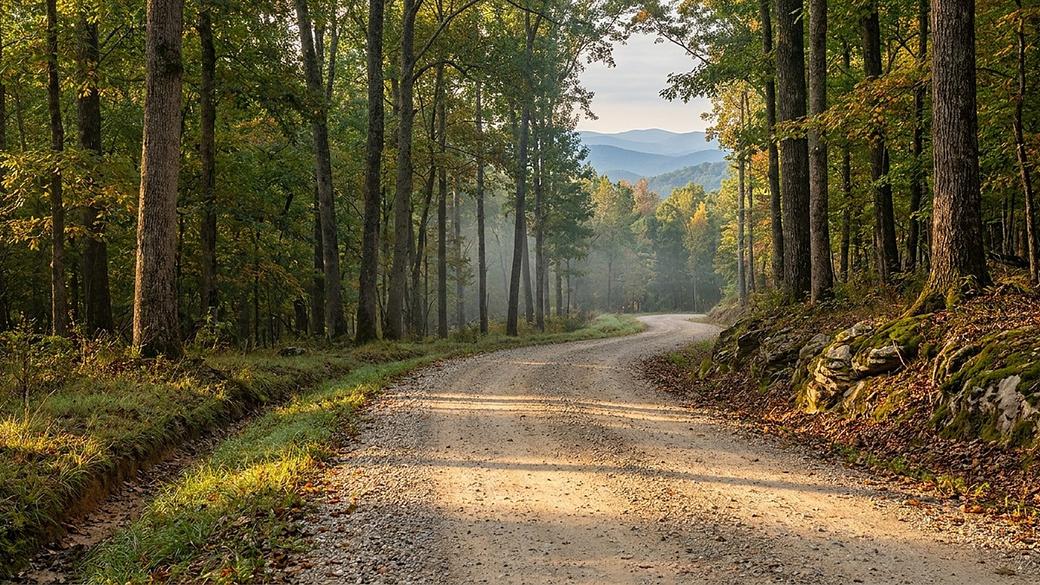
Most guides to the VA home loan benefit are written for a subdivision on a paved public street with city water and city sewer. That describes part of Dahlonega and very little of the rest of Lumpkin County. Out past the city limits, the same benefit meets gravel drives, shared wells, septic fields and easements written by hand in the 1970s. None of that disqualifies a property. It does mean the questions that decide your closing are questions about the land, and they are answerable before you ever write an offer.
What does a VA loan actually get you here?
The headline benefit is the one most buyers already know, and VA states it plainly: a VA-backed purchase loan offers "No down payment" as long as the sales price does not exceed the appraised value. VA reports that nearly 90% of VA-backed loans are made with no down payment. For a buyer who has the income to carry a house but not years of saved cash, that is the difference between buying this year and waiting.
The benefit most buyers underrate is the second one. VA lists "No need for private mortgage insurance (PMI) or mortgage insurance premiums (MIP)". Conventional and FHA borrowers putting little money down carry a monthly insurance charge that buys them nothing. A VA borrower does not. Over a thirty year loan that gap compounds into real money, and it is the reason a VA buyer can often carry more house at the same monthly payment than a conventional buyer with the same income.
VA also lists "Fewer closing costs, which may be paid by the seller" and "No penalty fee if you pay the loan off early". The tradeoff is the funding fee, covered in the next section, and one requirement that is not negotiable: VA requires that "You will live in the home you're buying with the loan". This is a benefit for buying a home, not for buying a rental or a weekend cabin you visit in the fall.
What will the funding fee cost, and who pays nothing?
The VA funding fee is a one time charge that funds the program itself. It can be rolled into the loan, which is what most buyers do. The rate depends on your down payment and on whether this is your first use of the benefit. These are the rates VA publishes for purchase loans, shown on its funding fee page as effective April 7, 2023.
| Down payment | First use | After first use |
|---|---|---|
| Less than 5% | 2.15% | 3.3% |
| 5% or more | 1.5% | 1.5% |
| 10% or more | 1.25% | 1.25% |
Read the second column before you decide to put nothing down. A repeat user of the benefit pays 3.3% with less than 5% down and 1.5% at 5% down, so on a second VA purchase a modest down payment cuts the fee by more than half. On a first use the same move takes 2.15% to 1.5%. Whether that trade is worth it depends on what else you would do with the cash, which is a conversation for you and your lender, not a rule.
VA lists the exemptions directly. You will not owe the fee if "You're receiving VA compensation for a service-connected disability", or if "You're eligible to receive VA compensation for a service-connected disability, but you're receiving retirement or active-duty pay instead", or if "You're receiving Dependency and Indemnity Compensation (DIC) as the surviving spouse of a Veteran". A service member with a proposed or memorandum rating from a pre-discharge claim also qualifies, as does an active-duty member who provides evidence of a Purple Heart on or before the closing date. If any of these describe you, confirm it in writing with your lender early. It changes your cash to close.
Is there a limit on what you can buy in Lumpkin County?
For most buyers here, no. VA is direct about it: if you have full entitlement, "You don't have a loan limit (as long as you can afford the loan amount and the property appraisal supports the purchase price of the home)". The practical ceiling is what your lender will approve and what the appraisal supports, because VA also states that "The maximum VA loan on an individual property is either the appraised value of the property or the purchase price, whichever is lower."
County limits re-enter the picture only if your entitlement is reduced, which typically means you have another VA loan outstanding or a prior one that was not fully restored. In that situation the county conforming loan limit value is used to work out your remaining entitlement. For 2026 the Federal Housing Finance Agency sets the one-unit conforming loan limit value in Lumpkin County at $832,750.
One detail is worth knowing before someone tells you otherwise: Georgia has no high-cost county. Reading FHFA's own 2026 county file, all 159 Georgia counties carry the same $832,750 one-unit value, so Lumpkin is neither penalized nor advantaged relative to Fulton or Forsyth. The 2026 baseline rose $26,250 over 2025.
"The entitlement question usually takes one phone call. The property question is the one that costs people their closing date, and it is almost always answerable in an afternoon of reading the deed records and looking at where the water comes from."
Gold Peach Realty, Dahlonega
Will a North Georgia property pass the VA appraisal?
VA appraisals apply a published set of Minimum Property Requirements, laid out in Chapter 12 of the VA Lender's Handbook. They exist to protect the buyer from inheriting a house that is not safe, sound or sanitary. They are not a home inspection, and VA says so: an appraisal "estimates the house's market value at the time of inspection. An appraisal isn't a home inspection or a guaranty of value." Order your own inspection regardless.
Most of Chapter 12 is uncontroversial for a typical house. The provisions that decide outcomes around Dahlonega are the ones covering access and water, because those are the two things a mountain property is most likely to handle differently from a subdivision lot. The next two sections take them one at a time.
What if the home is on a well, a septic system or a shared well?
All three are workable. Each has a rule attached, and the rules are specific enough that knowing them ahead of time prevents nearly every ugly surprise.
A private well serving one house
Water quality has to satisfy the health authority with jurisdiction, and where the local authority has no standard, the EPA guidelines apply. The requirement that catches people is who is allowed to handle the sample. VA is explicit: "All testing must be performed by a disinterested third party. This includes collecting and transporting the water sample from the water supply source," and "At no time will the Veteran or other interested party collect and/or transport the sample." A helpful seller or an eager buyer dropping a sample off at the lab invalidates the result. Let the health department or a commercial lab do the whole chain.
Timing matters too. Water quality test results "are valid for 90 days from the date certified by the local health authority unless the local authority indicates otherwise." On a long closing or a delayed build, a test taken too early expires and has to be redone.
Some water sources trigger extra paperwork rather than a rejection. VA requires the appraiser to comment and the buyer to acknowledge in writing when water comes from dug wells, cisterns or hauled water held in tanks, from a mechanical chlorinator, from springs, lakes, rivers, sand-point or artesian wells, or from a rainwater catchment system. A spring-fed property is not disqualified. It is documented.
Septic
The standard is functional rather than technical: an individual sewage disposal system must "adequately dispose of all domestic wastes in a sanitary manner which will not create a nuisance, or in any way endanger the public health." Health authority approval of the system is required on proposed construction, on any case where the appraiser notes a problem, and where "the area is known to have soil percolation problems." If you are buying land to build, or buying a house where the drain field's condition is unknown, budget the time for that approval rather than discovering it on the appraisal report.
A shared well
This is the one that most often stalls a closing here, because the fix is a recorded document that may not exist yet. A shared well serves two or more properties, and VA requires it to be capable of supplying safe, potable water to each property simultaneously in sufficient quantity for all domestic purposes, to be "protected by a permanent easement, which allows for maintenance and repair," and to be "maintained under a well-sharing agreement containing provisions for the cost of repairs that is binding on the signatory parties and successors in title and has been recorded in public records."
Read that last clause closely. A neighborly handshake is not a well-sharing agreement. The agreement has to bind future owners and it has to be recorded. If the property you want shares a well and no recorded agreement exists, that document has to be drafted, signed by the other owners and recorded before the loan can close, and the other owners have no obligation to cooperate on your timeline. Find out in week one.
What if the home is on a private road?
Gravel and shared drives are ordinary here, and VA accommodates them. The baseline is that "Each property must be provided with a safe and adequate pedestrian or vehicular access from a public or private street with an all-weather surface." All-weather is the operative phrase, and it is about whether the surface stays passable, not about whether it is paved.
Then the specific requirement: "Private roads must be: protected by a permanent easement, and maintained by a homeowners association or joint maintenance agreement." If no maintenance agreement exists, VA's guidance is that every effort should be made to get the owners along the road to agree to share the cost. Where the road sits inside a planned unit development or condominium whose documents already cover street maintenance, that is usually enough on its own.
When owners will not sign, a buyer is sometimes asked to take on a disproportionate share of the road to make the file work. VA limits this. Any such agreement has to be reasonable given the distance from the property to the public road and has to be approved by the VA Regional Loan Center, and VA states that it "will not accept an agreement in which the Veteran accepts sole responsibility for maintaining an unreasonable distance of the private road as this could create a burden for the Veteran as well as future property owners." If someone suggests you simply sign for the whole road to save the closing, that protection exists for a reason.
What property tax break do disabled veterans get in Georgia?
Georgia's disabled veteran homestead exemption is substantial, and it is the single largest carrying-cost difference between a qualifying veteran and any other buyer on the same street. The Georgia Department of Revenue describes it as an exemption of "the greater of $32,500.00 or the maximum amount which may be granted to a disabled veteran under Section 2102 of Title 38 of the United States Code, as amended", applied against ad valorem taxation for state, county, municipal and school purposes.
Because that second figure is tied to a federal amount that changes, the dollar value moves year to year. The Department of Revenue publishes it with the year attached: "The amount for 2025 is $121,812." Compare that to the ordinary statewide homestead exemption of $2,000 under O.C.G.A. 48-5-44 and the scale is obvious.
Two practical notes. The Department of Revenue has not published a 2026 figure on that page as of this writing, so confirm the current year's amount with the Lumpkin County tax commissioner rather than assuming last year's number carries forward. And the benefit does not end with the veteran: the exemption extends "to the unremarried surviving spouse or minor children as long as they continue to occupy the home as a residence." Exemptions are not automatic. Someone has to file.
How do you start, and in what order?
- 1Get your Certificate of EligibilityVA calls the COE "the first step in getting a VA-backed home loan" and says it "confirms for your lender that you qualify for the VA home loan benefit." You can request it online, have your lender pull it through Web LGY, which is usually fastest, or mail VA Form 26-1880 to your regional loan center. Mail takes longer.
- 2Get underwritten, not just prequalifiedThe COE proves entitlement. It does not approve you. VA still requires that you meet its standards and your lender's standards for credit and income. In a market with limited inventory, a fully underwritten preapproval is what makes your offer competitive against cash.
- 3Screen the property before the appraisalThis is the step that saves money in Lumpkin County. Before you spend on an appraisal, establish three things: how the property gets its water, how it handles sewage, and whether the road to it is public or private. If the answers include a shared well or a private road, ask for the recorded easement and maintenance or well-sharing agreement now.
- 4Write the offer with the real timeline in itIf a document has to be drafted, signed by neighbors and recorded, your due diligence period needs to reflect that. Deals fail here on calendars more often than on credit.
- 5Order your own inspection anywayThe VA appraisal is not an inspection and does not guarantee value or condition. On an older mountain property, the inspection is what tells you about the roof, the crawl space and the well pump.
- 6File for your exemptions after closingIf you qualify for the disabled veteran homestead exemption, file with the county. Nobody applies it for you.
Why do military buyers keep landing in Dahlonega?
Part of the answer is that the Army is already here. The U.S. Army describes Camp Frank D. Merrill as the place where "the U.S. Army's 5th Ranger Training Battalion, Airborne and Ranger Training Brigade, leads the mountain phase of the U.S. Army Ranger Course," a three-week segment of the nine-week Ranger Course, and Army University Press places the camp at Dahlonega, Georgia. Cadre rotate through, families see the town, and some of them come back to buy in it.
The other part is the university. The University of North Georgia describes itself as "a designated State Leadership Institution and as one of only six Senior Military Colleges in the nation, The Military College of Georgia," with its Corps of Cadets on the Dahlonega campus. A town of this size with a senior military college in the middle of it has a population that understands orders, deployments and the specific rhythm of a military household, which is not something every mountain community offers.
If you are weighing the move itself rather than the financing, our guide to living in Dahlonega and the pros and cons of moving to North Georgia covers the daily-life side honestly, including the tradeoffs.
Let us check the property before you spend a dollar on it
Access, water source and recorded agreements are things we can look into before you commit. That one review is usually the difference between a VA closing that runs on schedule and one that loses two weeks waiting on a neighbor's signature.
Browse Dahlonega homes for sale with Gold Peach Realty or call (770) 283-1223.
Start the ConversationFrequently Asked Questions
Can I use a VA loan to buy a home in Dahlonega with no money down?
Generally yes. VA lists "No down payment" as a purchase loan benefit as long as the sales price does not exceed the appraised value, and VA reports that nearly 90% of VA-backed loans are made with no down payment. Your lender still has to approve you on credit and income, and the appraisal still has to support the price.
Is there a maximum VA loan amount in Lumpkin County?
Not if you have full entitlement. VA states that with full entitlement you do not have a loan limit, as long as you can afford the amount and the appraisal supports the price. If your entitlement is reduced because you have another VA loan outstanding, the county conforming loan limit value comes into play, and for 2026 that value in Lumpkin County is $832,750.
Can a VA loan buy a house on a private well?
Yes. The water has to meet the requirements of the health authority with jurisdiction, and the sample must be collected and transported by a disinterested third party. Neither the buyer nor any other interested party may handle the sample. Results are valid for 90 days from the date the local health authority certifies them, unless that authority says otherwise.
What happens if the property shares a well with a neighbor?
It can still work, but three conditions apply. The well must supply safe potable water to each property simultaneously in sufficient quantity, it must be protected by a permanent easement allowing maintenance and repair, and it must be maintained under a well-sharing agreement that covers repair costs, binds successors in title, and has been recorded in public records. If no recorded agreement exists, get that process started immediately, because it depends on other owners signing.
Will VA lend on a home at the end of a gravel road?
Surface type is not the test. VA requires safe and adequate access from a public or private street with an all-weather surface. If the road is private, it must be protected by a permanent easement and maintained by a homeowners association or a joint maintenance agreement. A well-kept gravel road with a recorded maintenance agreement is in better shape for VA purposes than a paved private lane with no agreement at all.
Can I be asked to take responsibility for the whole private road?
You can be asked, and VA limits what it will accept. Any agreement in which a veteran takes on a disproportionate share has to be reasonable relative to the distance to the public road and must be approved by the VA Regional Loan Center. VA states it will not accept an agreement in which the veteran accepts sole responsibility for an unreasonable distance of private road, because of the burden that creates for the veteran and for future owners.
Do I have to pay the VA funding fee?
Not if you fall into one of VA's exemption categories. Those include receiving VA compensation for a service-connected disability, being eligible for that compensation but receiving retirement or active-duty pay instead, receiving Dependency and Indemnity Compensation as a surviving spouse, holding a proposed or memorandum rating from a pre-discharge claim, or being an active-duty member who provides evidence of a Purple Heart on or before the closing date.
How much is the funding fee if this is my second VA loan?
For a purchase loan after first use, VA's published rate is 3.3% with less than 5% down, 1.5% with 5% or more down, and 1.25% with 10% or more down. The jump from 3.3% to 1.5% at a 5% down payment is large enough that it is worth running both scenarios with your lender before deciding to put nothing down.
Does a VA appraisal replace a home inspection?
No. VA describes the appraisal as an estimate of market value at the time of inspection and states plainly that it is not a home inspection or a guaranty of value. On older properties, wells, crawl spaces and roofs are exactly the areas a separate inspection is for.
Can I use a VA loan for a cabin I will only use on weekends?
No. One of VA's stated requirements for a purchase loan is that you will live in the home you are buying with the loan. The benefit is for a primary residence, not a second home or an investment rental.
What property tax exemption do disabled veterans get in Georgia?
Georgia grants a qualifying disabled veteran an exemption of the greater of $32,500 or the maximum amount that may be granted under Section 2102 of Title 38, applied against state, county, municipal and school ad valorem taxes. The Georgia Department of Revenue publishes the figure with a year attached, and states that the amount for 2025 is $121,812. Confirm the current year's amount and the filing deadline with the Lumpkin County tax commissioner.
Does that exemption pass to a surviving spouse?
The Department of Revenue states that the exemption extends to the unremarried surviving spouse or minor children as long as they continue to occupy the home as a residence. The filing still has to be made with the county.
How do I get a Certificate of Eligibility?
Three ways. Request it online, have your lender obtain it through Web LGY, or mail a completed VA Form 26-1880 to your regional loan center. VA notes that mail requests may take longer than the other two routes. The lender route is usually the fastest.
Should I get the COE before I start looking at houses?
It is the sensible order. VA calls it the first step, and having it in hand means your preapproval is not waiting on paperwork when you find the right property. In a low-inventory market, the days you save there are the days that matter.
Are there other low-down-payment options if I am not eligible for a VA loan?
Yes. Much of Lumpkin County sits in areas where USDA financing is worth checking, and Georgia Dream assistance helps some first-time buyers. Our guide to USDA loans in Dahlonega and first-time buyer programs walks through those alongside FHA and conventional options.
Important: This article is general information about the VA home loan benefit, VA Minimum Property Requirements and Georgia property tax exemptions. It is not lending, legal or tax advice. Federal funding fee rates, conforming loan limit values and Georgia exemption amounts are summarized as published at the time of writing, are cited so readers can consult the source directly, and change on their own schedules. Eligibility, loan approval and final terms are determined by your lender and by the U.S. Department of Veterans Affairs. Exemption eligibility and amounts are determined by the county tax commissioner. Property conditions, easements, well-sharing agreements and road maintenance agreements must be independently verified against the current recorded documents by the buyer, seller or their licensed representative before any real estate decision. Gold Peach Realty is a licensed Georgia real estate brokerage, broker Nicole Van den Bergh, License 381292. Equal Housing Opportunity.
Looking for homes in North Georgia? Visit Gold Peach Realty at goldpeachrealty.com, your local experts in Dahlonega, Gainesville and the surrounding mountain communities. Call (770) 283-1223.
Last updated:
Categories
- All Blogs (664)
- Achasta Golf Community (78)
- Cleveland, GA (47)
- Dacula, GA (43)
- Dahlonega GA (166)
- Dawsonville, GA (46)
- Forsyth County, GA (2)
- Gainesville, GA (47)
- Gold Peach Realty (36)
- Helen, GA (44)
- Home Buying Tips (42)
- Home Décor And Interior Design (7)
- Home Improvement Tips (15)
- Home Selling Tips (29)
- Homes For Sale (56)
- Lake Lanier, GA (72)
- Land & Acreage (2)
- Local Events (13)
- Local Guides (27)
- Luxury Real Estate (3)
- Market Reports (17)
- Mortgage And Finance Tips (27)
- New Construction (2)
- North Georgia (47)
- Relocating To North Georgia (19)
Recent Posts




GET MORE INFORMATION